
Water Literacy: Trees Make Rain
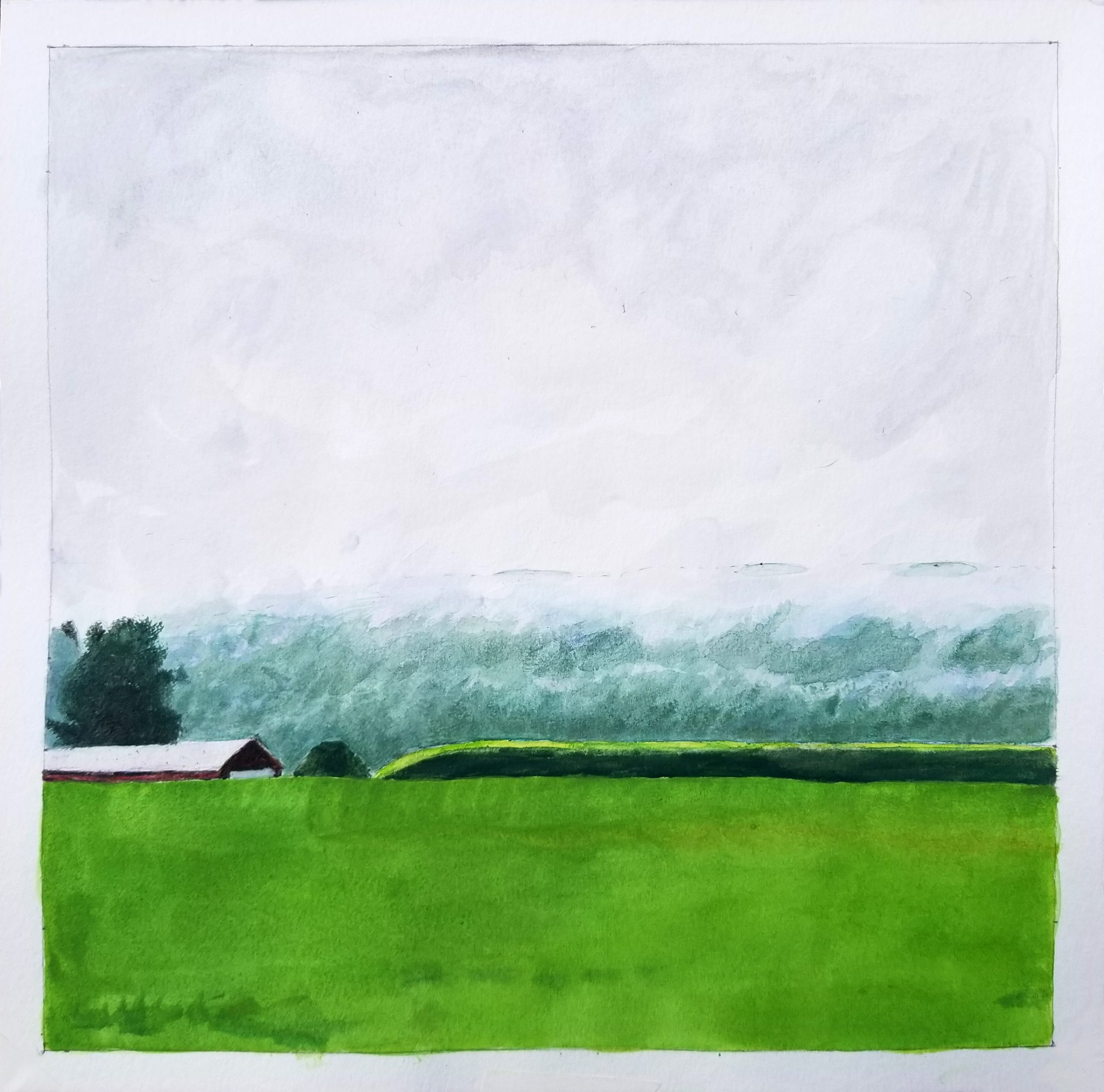
August 2022: Yet another severe drought dried up my well, as I began my second semester in Goddard College’s MFA in Interdisciplinary Fine Art. Droughts are now more frequent. Again I toted water from the spring, took sponge baths, watered plants with dish water, while trying to do graduate work. In mid-October it finally rained. Miraculous mist rose from forests everywhere. I suddenly realized I was watching trees make clouds. I painted this watercolor from a photoshoot I did that misty day. I’d never painted mist before. I invented my way through it. This was my first piece for the Water Literacy Project.
A New Paradigm: How Biotic Life Regulates Earth’s Climate:
Our understanding of climate change is changing. It turns out biotic life regulates Earth’s climate, by orchestrating the flow of water vapor—Earth’s largest greenhouse gas—through photosynthesis, transpiration, and precipitation—and has done so for millennia.
Mature forests—biotic life—transpire mist, which rises to become clouds, carrying excess heat high into the sky. On condensation, this heat is released to outer space, precipitating rain which nourishes all life, and regulating Earth’s temperature to be ideal for life. But human activities have stripped biotic life from 40% of Earth’s surface (and growing), so now Earth’s ecosystems can’t maintain our climate properly. Plants also breathe in carbon dioxide from the atmosphere, absorbing and returning carbon back to the soil. As forested areas and plant life are diminished, there are fewer plants to draw carbon from the atmosphere.
July, 2016: During our worst drought in 50 years, I learned trees seed 2/3 of rain:
The Water Literacy Project, beginnings:
Early Seeds: In 2019, I’d read a chapter in “Staying with the Trouble” by Donna Haraway, where she spoke of the Anthropocene, a term proposed for our geologic epoch by ecologist Eugene Stoermer and Nobel-Prize-winning atmospheric chemist Paul Crutzen in 2000, identifying human activity as the greatest impact on Earth’s lands, atmosphere, and water. But Haraway asks us to be more discerning. She suggests, if one word is chosen for the existential environmental polycrisis confronting our epoch, it should be called the Capitalocene, where corporate extraction is causing most of the damage to the environment, on a scale that is etched into Earth’s surface, and will be a lasting record of this time.
I thought: If humans create these impacts, then transforming human lifeways is essential to planetary healing. Artists, whose work is envisioning new ways of seeing and being, can help rechart our cultural pathways, so we may rejoin in regenerating Life’s thriving. Art can help people visualize the connection between trees and rain.
This page will be a fluid “open studio”, in flux as the project evolves. I’ve found this project asks for careful listening. Perhaps embracing imperfection, continuously being in-process, is part of re-humaning. This project will become more collaborative over time.
How forests cool Earth through photosynthesis and transpiration:
How forests cool us. Each tree is equivalent to two air conditioners (or more) a day:
How fossil fuels and extraction of all kinds is contributing to our climate crisis:
While fossil fuels contribute enormously to the rise in atmospheric carbon, removing Earth’s green living ecosystems from lands also severely contributes to rising carbon. Plants remove carbon from the atmosphere, and return it back to the soil. An example: the vast coal tar sands mining project in Alberta, Canada has turned a vast area to into a devastated moonscape. The impact is multiplied: extracting; burning fossil fuels; and scraping back the ancient biodiverse forests that once were there removing atmospheric carbon, cooling the land and sky. Extraction of all kinds devastates land, accelerating climate change.
Trees create the atmospheric rivers that bring rain around the planet:
These 'Rivers in the Sky' carry more water than in all the rivers on Earth.
• Trees also replenish the aquifers, gathering up rain through their surface roots, helping water absorb into the soil, performing hydraulic distribution.
Protecting ancient forests, regenerating green lands, is mission critical to reverse climate change. Our present and future is intertwined with the whole interconnected family of biodiverse life. Our acts, small and large, to honor, rejoin, and restore Life’s thriving are necessary.
October 16th Photo Journal – River Mist Becoming Clouds
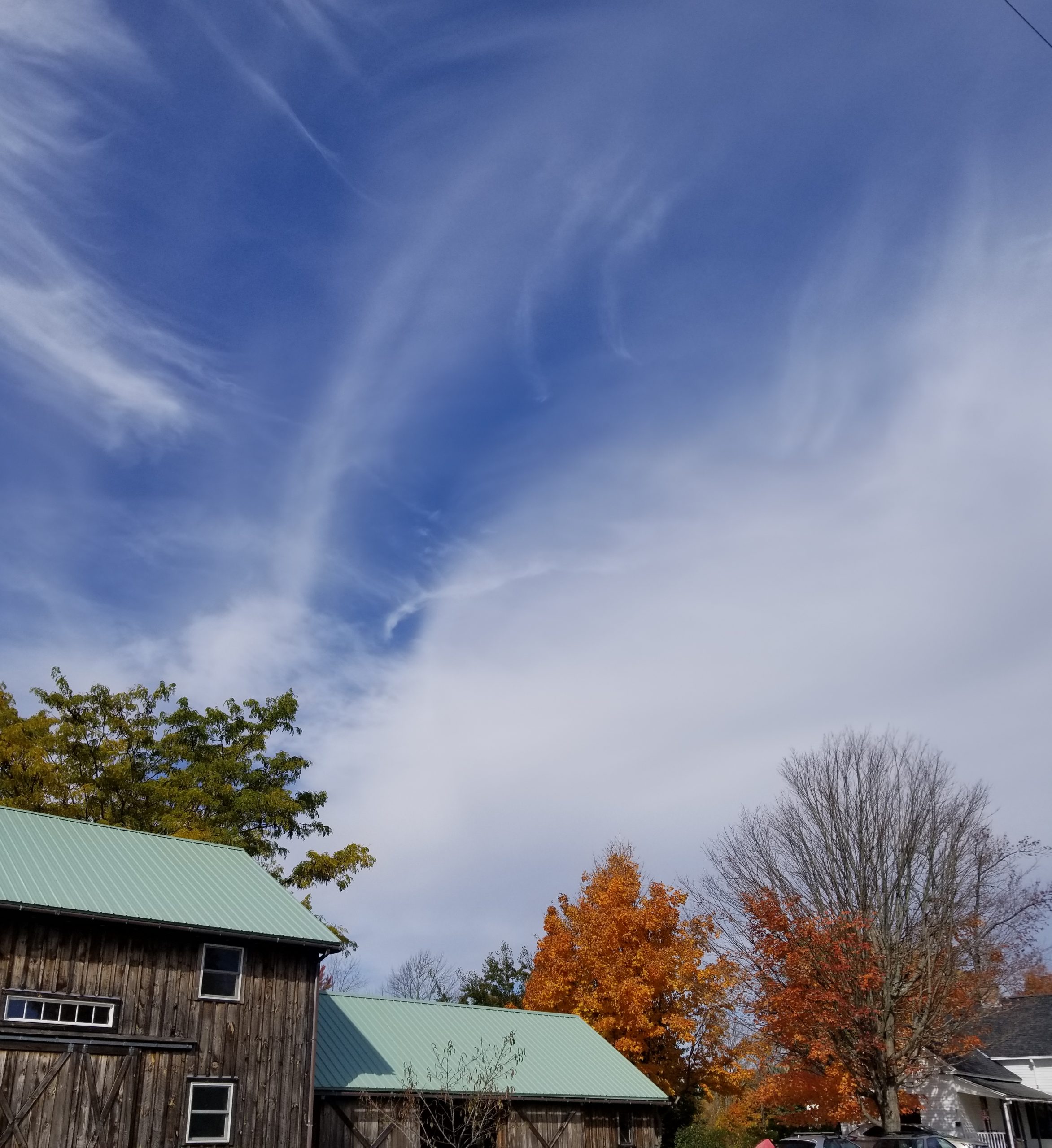
After painting Trees Making Mist, I wondered how forest mist rises to become clouds in the sky. One morning soon after, something said, “Go out for breakfast”. As I drove down into the valley, I saw flowing swells of mist rising from the Connecticut river below. Adjusting my plan, I detoured to find the river and did a photoshoot. The mist lasted for a just a short window of time. Then I went to breakfast. Driving back up the long hill home, the river mist had gone, but was now rising up the hill. Long strands of mist streamed up towards the sky. I continued to photograph all the way home. I created this photojournal in Google Photos. I enjoyed the fluidity of this format, which allowed me to play with sequencing and weave a journal in with the photos. My 75-image photoshoot was curated down to 37 images. I see this as a time-based piece, documenting the transformation of river mist becoming clouds.
Photojournal: https://photos.app.goo.gl/oZa77rsGsHwgQ6nY6
Writings on Trees and Rain:
That fall, I wrote extensively about emerging forest science on what has come to be known as the Biotic Pump Theory, or Biotic Climate Regulation, which reveals how trees literally create the winds and atmospheric rivers that bring rain to every place on Earth. These writings describe connections between trees and rain, and also connections between deforestation and desertification. This emerging science continues to transform how we think about climate change.
I’ve written about deforestation and desertification throughout history (for example, how the Romans desertified the Sahara); deforestation now; and inspiring recent forest regeneration projects which show us how we can recover. I’ve written about my artistic lineage with trees (my BFA senior thesis project was about trees), and my personal connections to this work through my family [my grandfather had a lumber company, and my great-great uncle founded S. D. Warren Paper Company (he was the first to use trees instead of rags for paper)]. Working on this project, I’ll take time to listen deeply to forests, and the families of life living within them; letting them show me the work.
Links to Trees Writings:
- Trees and Water and the 2016 Drought.
- Trees are the Life Support System of the Planet.
- Deforestation, Trees, Rain, Desertification in Ancient History.
- My Artistic Lineage and Trees
- My Heritage Lineage with Trees
Elesia’s Song:
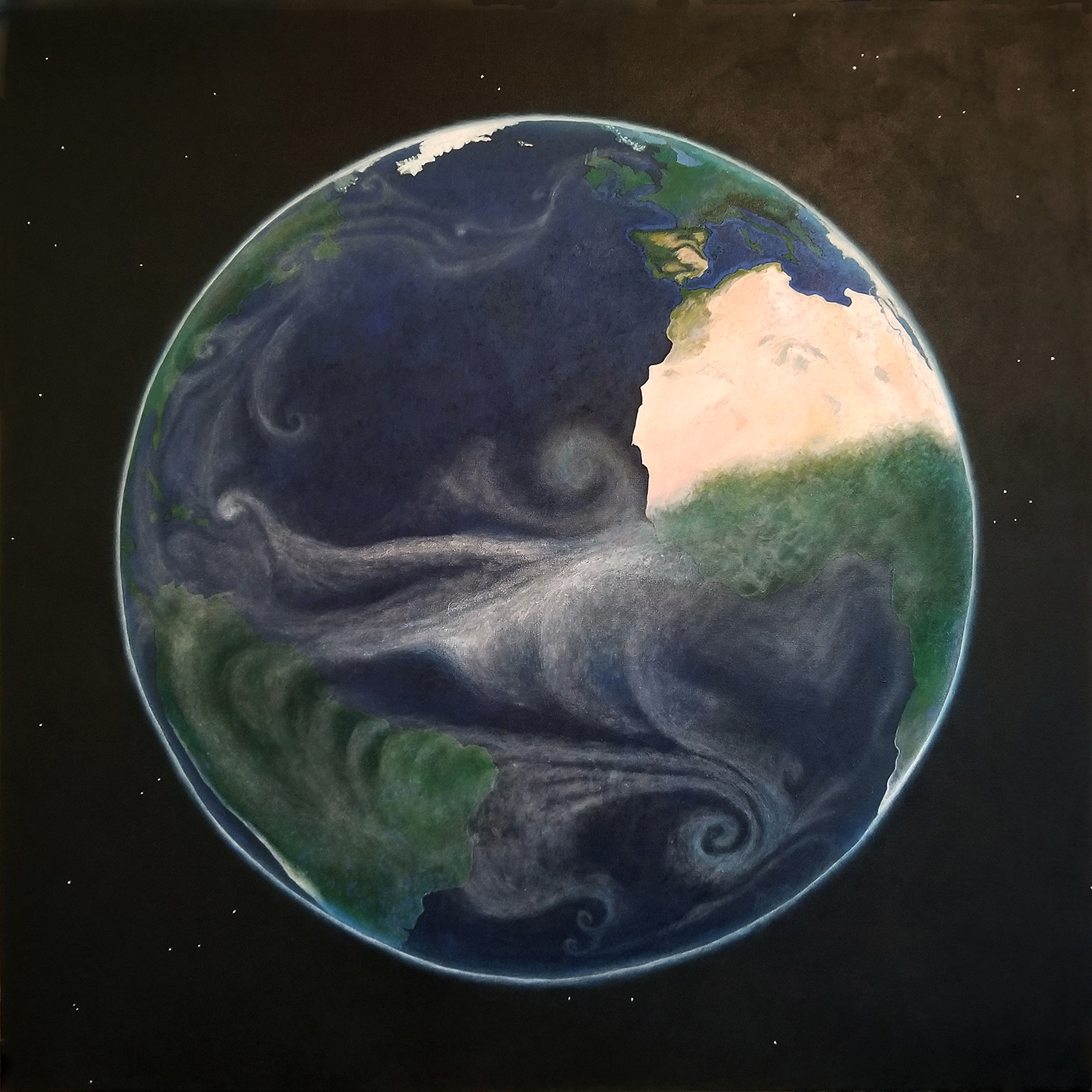
I decided to create a painting of the atmospheric river that brings rain to New England. This atmospheric river originates 5000 miles away in the Congo Basin, crosses the Atlantic Ocean, picks up more moisture from the great Amazon Rainforest, travels up through the Gulf of Mexico, and up the East Coast (or sometimes into the Midwest, or sometimes spiraling out to sea). I wanted to help people visualize how vast this atmospheric river is, that brings us our rain—how many hundreds of communities it passes over. Every community receiving the blessing of rain, and every community giving something to the river, for good or ill. We are all interconnected through this river in the sky.
I made contact with scientists at NOAA’s CIRA Institute at University of Colorado, who provided me with long sequences of satellite imagery, from which I made animations, so I could study the atmospheric river flow to paint it (the CIRA science team are who make the animated satellite loops for the daily NOAA weather report). I also worked with Google Earth hurricane imagery, and animations from NOAA’s Science on a Sphere Program. This was essentially a landscape painting from the vantage point of outer space, so I needed help from satellites, to capture the view. I also worked with Elliot Severn, Director of the Planetarium at the SHU Discovery Center in Bridgeport, CT. This museum has a large display of NOAA’s Science on a Sphere Project. He helped me locate a particular animation I’d seen of Earth’s forests literally breathing moisture into the atmospheric rivers. He also helped by providing me with a star map for the same date as the animation, so I could paint the starscape behind Earth. My many thanks go to all the wonderful folks who helped me.
At one point, I decided to talk to the atmospheric river. I said, “I can’t keep calling you atmospheric river all the time. Do you have a name?” The answer came back immediately, “My name is Elesia”.
Morning Mist in the Valley, Upper Rd. Plainfield, VT. August 3rd:
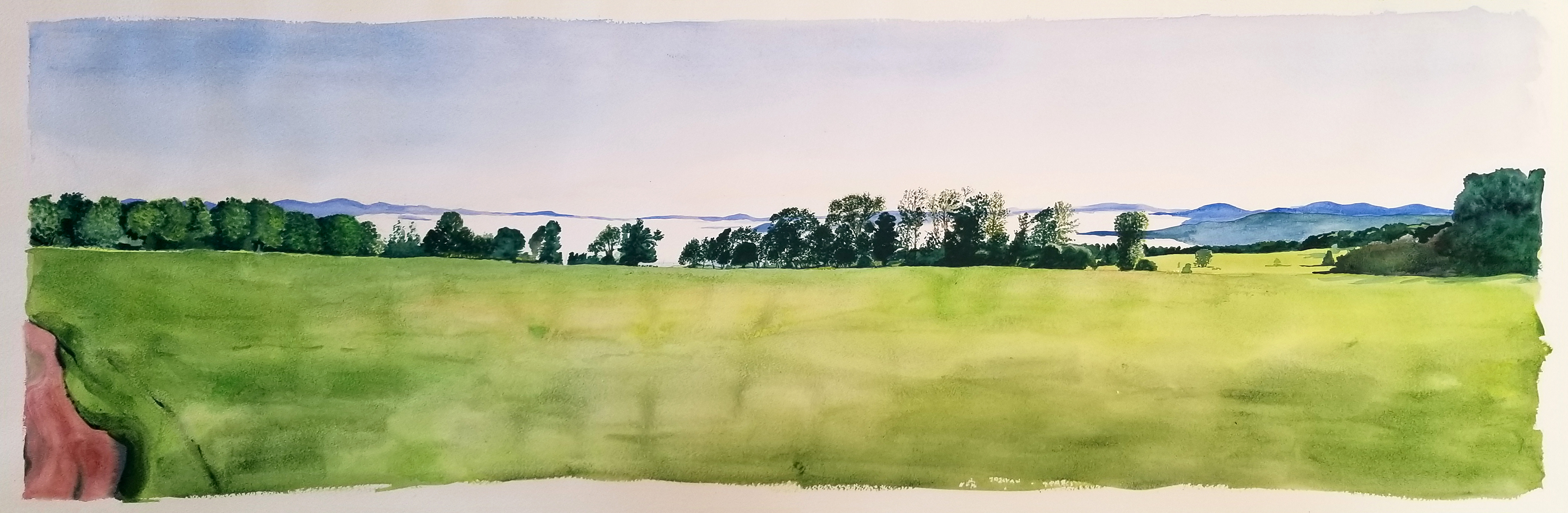
During my Fall 2023 Residency, I again did photoshoots of mist rising from the valley, in a big field across the road from my AirBnB, high on a hill in Plainfield, VT. I would watch the mist rise up in the early morning, like water filling a bathtub, then rise up the hills, and launch into the sky to become clouds. I wanted to do a really large watercolor of the mist. This piece is over four feet wide, and 18 inches high.